

Sakht Pooshesh aircraft parts repair
Around the world, companies operating under the supervision of specific aviation authorities carry out the repair and overhaul of aircraft components. Sakht Pooshesh Company, having obtained the required certifications, is listed among the approved aircraft component repair facilities.
By employing domestic specialists who hold valid national and international certifications, this company is considered one of the leading and top organizations in the field of aircraft component repair.
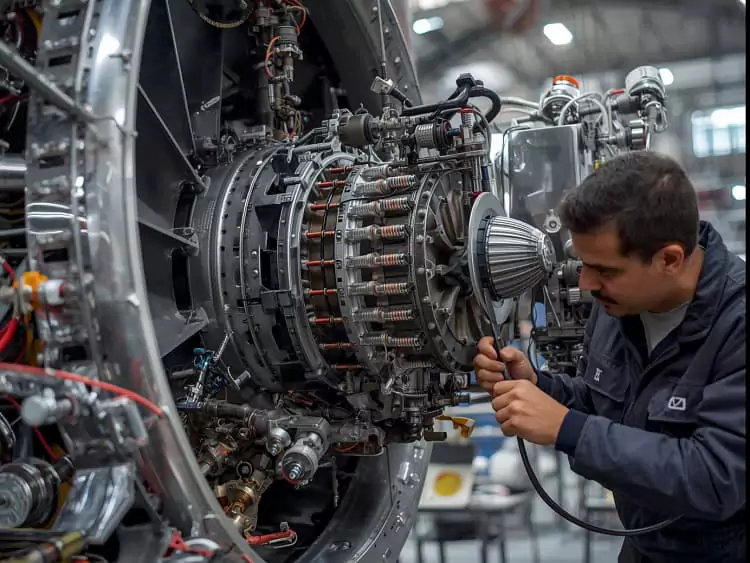
It holds a Part-145 certificate for the major overhaul and repair of various types of engine components.

Major repairs and overhauls of various main engine components such as: NGV, Vane, comp disk, stator, transition duct, liner, LPT shaft
Chemical, penetrant, and ceramic coating of component surfaces based on the relevant manuals
Chemical and mechanical cleaning (Plasto Blast) to prepare surfaces for repair
Performing non-destructive tests (NDT) according to BS EN4179, including FPI, MPI, UT, and ED at Level 4
Industrial silver plating on various components in accordance with aviation standards
Types of aircraft component repairs
Since the aviation industry is highly sensitive and requires constant and periodic inspection, we will review the types of services and repair processes used for aircraft engine components. Overall, this process is referred to as MRO (Maintenance, Repair, and Overhaul).
1- Maintenance :
Routine and periodic inspections that are usually performed based on flight hours (for example, every 300 flight hours). These inspections aim to prevent potential failures through regular checking and assessment.
2- Repair :
Repairing and resolving existing faults or defects. After inspections, if any component in the engine or airframe is identified as damaged or malfunctioning, it will be repaired or replaced.

3- Overhaul : Overhaul refers to major repair and complete restoration of a system to return it to a condition close to its original state.The MRO process includes several levels:
Level A : A superficial level performed after a specific number of flight hours, based on regional and national aviation standards. It includes visual inspections, system checks, and tasks such as examining aircraft oil.
Levels B & C : Performed every few months and are more detailed than Level A. They may be repeated at certain intervals and can take several weeks. During these inspections, the airframe and critical components may be opened and examined
Level D : This is the most extensive and in-depth level of maintenance and repair. In this process, the airframe, cabins, and engines undergo a full overhaul. Typically performed after several years, this level is the most comprehensive and expensive compared to the other levels.

The process of repairing aircraft engine components at Sakht Pooshesh
In general, the repair process for aircraft components may vary from one company to another. However, since this is a highly sensitive procedure with fixed and specific standards, the general and standardized process is as follows. Due to the sensitivity of the work, all procedures, including dates and the type of operations performed, must be fully recorded and archived.

- Receiving : In this process, the part is removed from the aircraft and handed over to the repair company. At this stage, the part’s information and serial number, along with its history, are recorded and stored in the information management systems.
- Cleaning: In this step, the part is cleaned using solvents and chemical methods to ensure that the repair and restoration process is carried out accurately and with high quality
- Detailed Inspection for Troubleshooting: At this stage, a detailed inspection is performed using Non-Destructive Testing (NDT) laboratories to precisely identify the problem. The NDT laboratory uses various methods, which are fully explained in the section on Non-Destructive Testing in the Hard Coating section.
- Repair or Replacement: In this stage, based on the needs of the part, some components may be replaced or repaired. Repair and replacement may involve methods such as welding, machining, plating, and processes that enhance the part’s resistance, such as shot peening.
- Functional Test: After completing all procedures and processes, a functional test is performed to check whether the issue has been fully resolved. This test may be done using detection tools and methods or through practical tests
- Documentation: In this stage, all processes performed on the part, along with the product’s serial number, are recorded and maintained. This process is carried out both by the repair company handling aircraft engine parts, such as Hard Coating, and by the airline companies for record-keeping, future servicing, and aircraft maintenance
- Certification: After repair, the part receives a repair certificate, which grants it approval for use in flight operations.
Aircraft Parts Repair Standards
The repair of aircraft components is governed by strict international standards to ensure the safety, reliability, and performance of the aircraft. Below are the key standards and guidelines commonly followed for aircraft parts repair

FAA Certificate (Federal Aviation Administration): This certification oversees the certification of repair stations and technicians in the United States. It has various internal levels. FAA 14 CFR Part 145 pertains to repair stations, while the FAA Form 8130-3 is used for part repair certification
EASA Certificate (European Union Aviation Safety Agency): EASA regulations focus on safety and the environment within the European Union and are among the most important standards for aircraft parts repair and maintenance worldwide. These regulations are set by the European Union, and airline companies in EU member states are required to comply with and enforce these laws. EASA Part-145 is one of the standards for repair and maintenance of aircraft parts, and the EASA Form 1 is the certificate for repaired parts.
ICAO Certificate (International Civil Aviation Organization):